
Understand what the safe is rated to do
A home safe may be sold for documents, valuables or general household storage, but those descriptions do not tell you how it was tested. The rating is more useful than the appearance of the door or the weight of the cabinet.
Two types of ratings matter when comparing safes: fire protection and resistance to attack. They measure different performance characteristics, and a safe intended primarily for one purpose may offer limited protection against the other.
Before choosing a safe, make a list of the items it will hold. Papers, stored valuables and items requiring different kinds of protection may lead to different choices. The right starting point is the contents, not the safe’s exterior size.
What a fire rating tells you
A fire rating describes how long a safe is intended to keep its interior below a specified temperature during a fire test. A common reference is 350°F inside the safe, with a time period such as one hour.
That means a one-hour fire rating refers to a tested period under specified conditions. It does not mean the safe cannot become hot, and it does not describe resistance to someone attacking the lock or cabinet.
Pay attention to both parts of the label: the time and the interior temperature threshold. A time printed prominently on a product is not enough information by itself to compare fire protection.
Think about the materials being stored. A homeowner preserving paper documents has a different storage concern from someone primarily securing items for their value. A fire rating should be considered in relation to those contents.
What RSC and TL-15 mean
Ratings for resistance to attack describe how a safe withstands physical attack. RSC stands for residential security container. It identifies a category of tested resistance rather than simply stating that a cabinet has a lock.
TL-15 is another rating for resistance to attack. It represents a more demanding tool-resistance testing category than the basic residential security container designation. The number refers to a defined testing period, not a promise about how long every real-world attack would take.
When comparing safes, keep these distinctions in mind:
- A fire rating measures heat protection under test conditions.
- RSC identifies a residential security resistance category.
- TL-15 identifies a higher tool-resistance category.
- One type of rating does not replace the other.
- The safe’s contents determine which protection matters.
A heavy door, thick-looking handle or electronic keypad does not establish a rating. Look for the actual classification rather than judging protection by appearance. A safe built for fire protection alone is not necessarily constructed to resist physical attack.
Why installation and anchoring matter
Choosing a safe is only part of the work. Placement and installation affect how it will be used and whether it can be secured to the property.
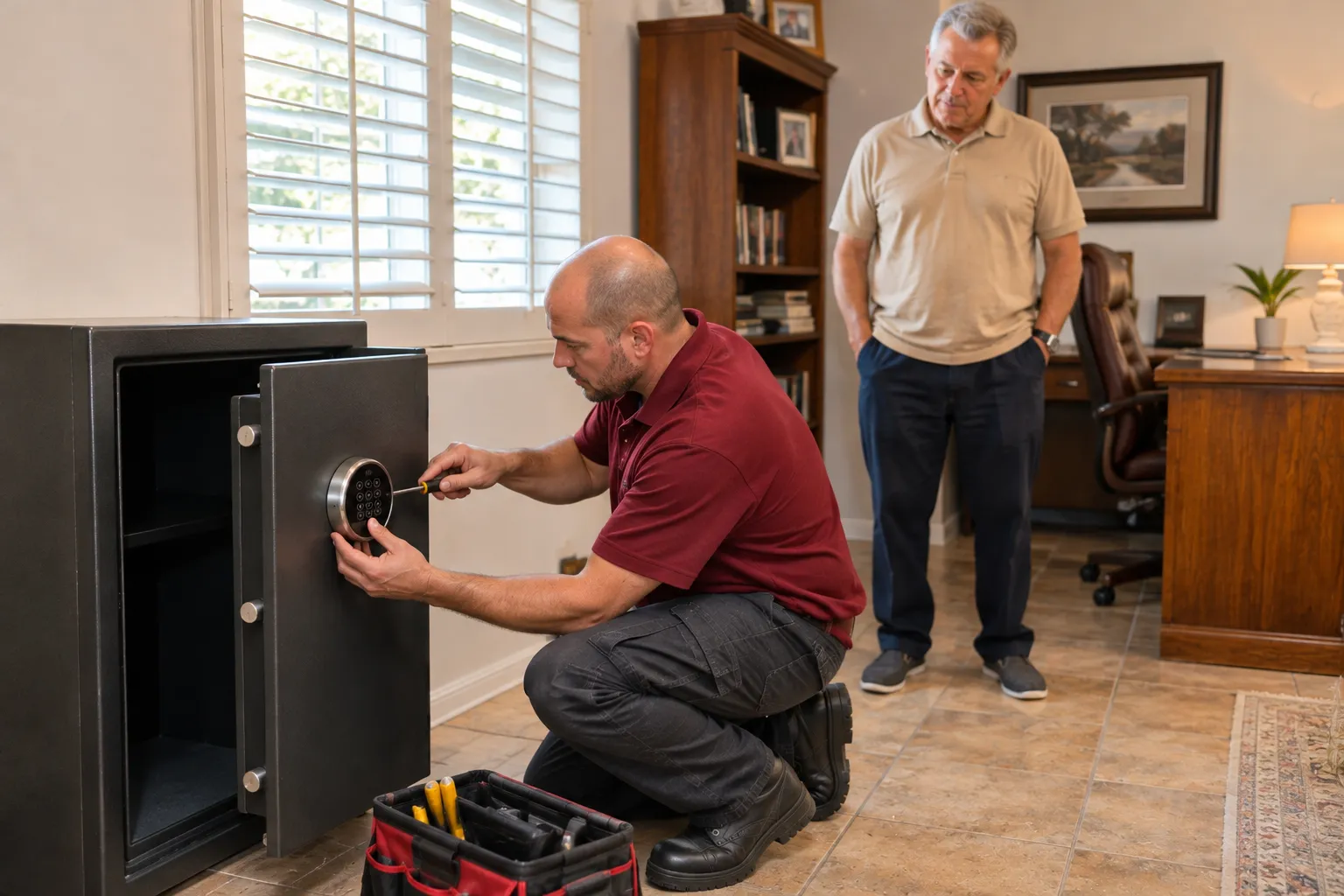
Anchoring a suitable safe to a concrete slab helps keep it in its intended position. Cairn provides safe installation and concrete slab anchoring, with the installation method determined by the safe and the site.
Size and access also affect the job. Cairn moves and delivers safes weighing up to 1,000 lb at ground level. Heavier units and moves involving stairs are referred to a safe mover.
Consider the installation location before ordering. A safe that cannot be transported to its intended position or anchored as planned may require a different arrangement.
Choose service as carefully as the safe
A safe can need service years after installation. Common requests include a lost combination, a dead electronic keypad, a failed lock or a combination change.
A locksmith inspects the safe and checks proof of ownership or authority before opening it. Some safes can be opened without damage, while others require drilling and repair. The method and price are determined after inspection, not promised over the phone.
Cairn also services mechanical and electronic safe locks and can replace a dial lock with a keypad on suitable equipment.
For a Las Vegas homeowner, the practical order is to identify the contents, compare the relevant ratings, plan the installation and keep ownership information available for future service. Each step answers a different question about the safe.