
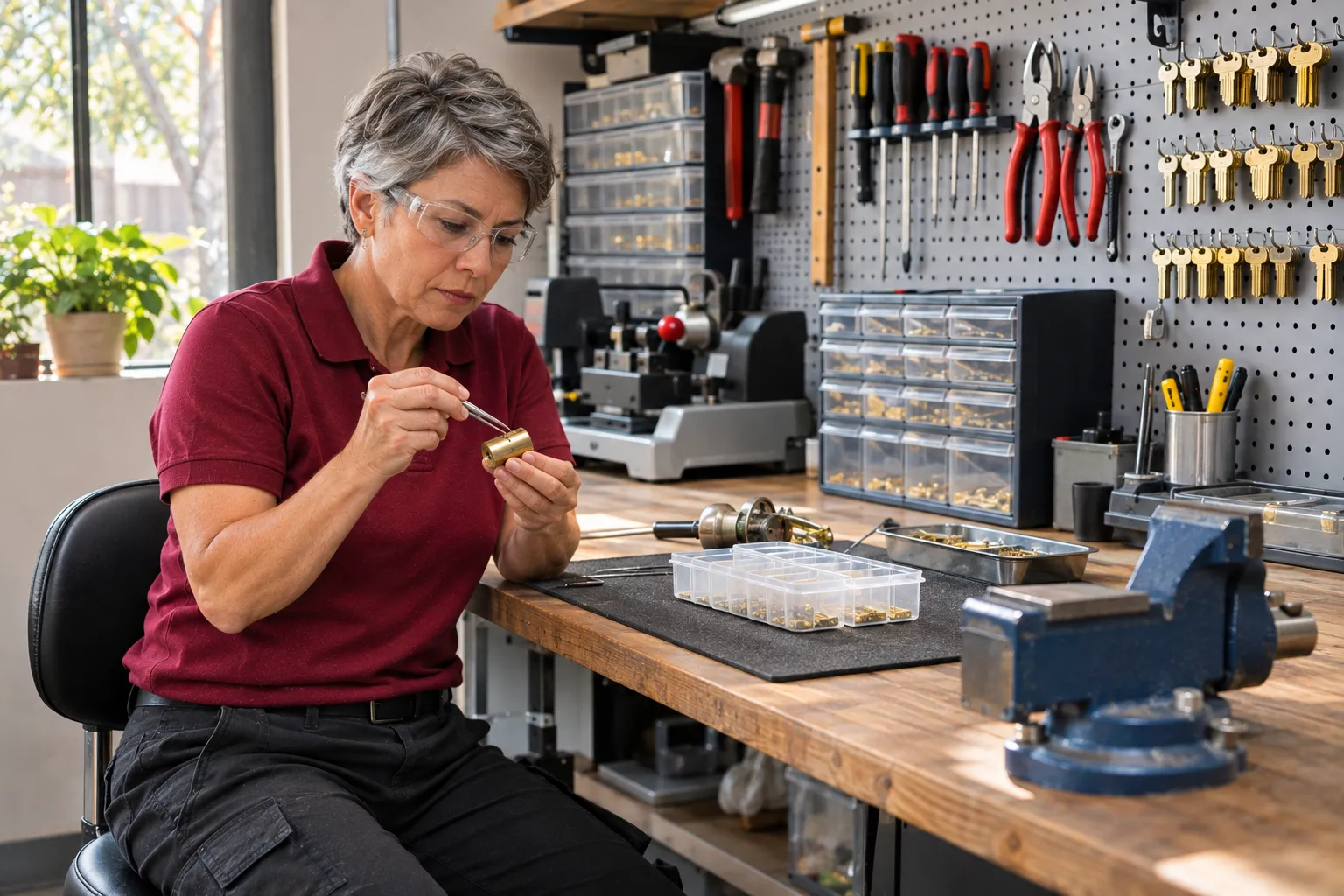
Start with control of key copies
A standard residential key can often be copied at a hardware counter or key kiosk. That is convenient for a household, but it gives a property manager little control over how many copies are circulating.
A restricted key system addresses that issue. Patented keyways use blanks supplied only through the contracted locksmith. A key holder cannot simply take the key to an ordinary kiosk and order another copy.
For Cairn’s restricted key customers, each issued key is stamped and logged. Additional keys are released to the authorized contacts named on the account, following a signed request.
This matters for offices, apartment properties and businesses where staff responsibilities change. The manager can keep a record of issued keys and decide who has permission to request more.
Restricted duplication is not the same as a promise that a key can never be copied. It establishes a controlled source for legitimate key blanks and a record of authorized requests.
High-security cylinders use stronger parts
High-security cylinders generally cost more than basic residential hardware because their construction and key systems are different. Hardened components add physical resistance, while the keyway design supports restricted duplication.
Some owners choose these cylinders for exterior business doors or for rooms that need more closely managed access. Others need an ordinary deadbolt installed correctly and do not require a restricted key system.
Look at the complete opening rather than the cylinder alone. A lock works with the strike, door and frame. A stronger cylinder does not repair a door that drags, a loose strike or worn hinges.
For a residential deadbolt, the bolt should extend a full inch into the frame. A reinforced strike plate secured with 3-inch screws reaching the wall stud is also part of a sound installation.
Understand Grade 1 before spending more
ANSI/BHMA lock grades describe hardware performance categories. Grade 1 is the highest grade and is commonly used for commercial doors and demanding residential applications. Grade 2 suits residential and light commercial use, while Grade 3 is basic residential hardware.
A Grade 1 rating does not automatically mean a lock uses restricted keys. A patented keyway and a hardware grade describe different characteristics.
When comparing options, ask which of these features the proposed hardware provides:
- A restricted source for replacement key blanks.
- Records showing who received issued keys.
- Hardened cylinder components.
- An appropriate ANSI/BHMA hardware grade.
- Compatibility with the existing door and frame.
Pay for the characteristics your property needs, rather than treating one label as proof of everything.
Account for the cost of future service
High-security hardware typically requires a larger initial investment than an ordinary residential cylinder. Restricted keys also require an authorized ordering process instead of a trip to a general key counter.
There is another tradeoff. If a high-security cylinder fails or seizes, ordinary non-destructive entry may not be possible. Drilling may be the only practical way to open it, followed by cylinder replacement.
Cairn inspects the hardware before deciding on an entry method. Any drilling, cutting or replacement requires the customer’s separate approval, with the price explained first.
That is worth understanding before installing restricted cylinders across a property. Key control has benefits, but replacement parts and future service belong in the budget.
Match the system to the property
Cairn services Medeco, Mul-T-Lock and Schlage Primus high-security systems. The selection depends on existing hardware, how many doors need controlled access and who is allowed to order keys.
For a home with working locks and no need to restrict duplication, rekeying may be sufficient to establish a new set of keys. For a commercial property with several authorized key holders, restricted cylinders and key records may provide more useful control.
A master key system can also be planned around departments or buildings, with selected rooms excluded. The aim is to give each authorized person the access needed for the job without distributing unnecessary keys.
Start by listing the doors, the people who need access and who may authorize duplicate keys. Those answers are more useful than buying the highest-priced cylinder without a plan.